Don Kowalewski
Writer. Ad Sales and Marketing. Social Media Content Creator. Aeropress Coffee. Makes the best salsa in the world.
The Birth Rate Thing

What’s the worst thing about Disney World? The crowds and the lines. Ever go to a beach at your favorite vacation spot and say to yourself, “back when we first started coming here, this was our own little secret and now I gotta fight for chairs and a spot close to the water with nobody blocking my view of the ocean (so I can take the perfect picture of my feet with the ocean as a backdrop)?”
I’ve stopped going to certain restaurants because they’re always so busy and there’s always a huge wait.
Birth rates seem to be a topic everyone wants to talk about right now, including the President thinking about giving $5,000 to couples who have a baby (honey? if you’re reading this … let’s talk …remember how we wanted a hot tub … $5,000 could come in handy for that … ). MSNBC …ahem, a news network that I watch … did an entire segment on declining birth rates. And Tangle, yesterday, was all about the birth rate.
Why is it happening? Is it financial stress? Is it lower fertility? Phones in our pockets? Phones entertaining us more than sex? Porn? Is the world so argumentative, ugly, and always-fighting that couples are saying, “I’m not bringing another human into this craziness?” Or is it just selfishness, as in, “a baby, or multiple babies, will prevent me from dinners out, exotic vacations, and buying things for ME?”
People come to this Blog for answers to life’s biggest questions, so let me float this out there … and I think it seems pretty simple … what if we’re just feeling overcrowded, like at Disney World or your former favorite vacation spot?
People talk about a rate-of-replacement needed by a society to sustain itself, and maybe that’s been true for thousands of years, but what if, now, as people are living longer and we’re not constantly fighting huge wars and diseases and plagues are fewer … do we need to replace ourselves like before? I listened to a Podcast about the ancient Romans and I remember reading about families in America in the 1800s, and it was almost a fact of life that if you had 5, 6, or 7 children, you would likely lose one or two. I should fact check that, but it feels right and, holy crap … when you put it in raw numbers, yes, having babies and the birth rate needed to be high for rate-of-replacement.
I’ve been thinking about generations and populations a lot (partly because I’m in marketing), and I wonder why nobody suggests that maybe overcrowding is a factor.
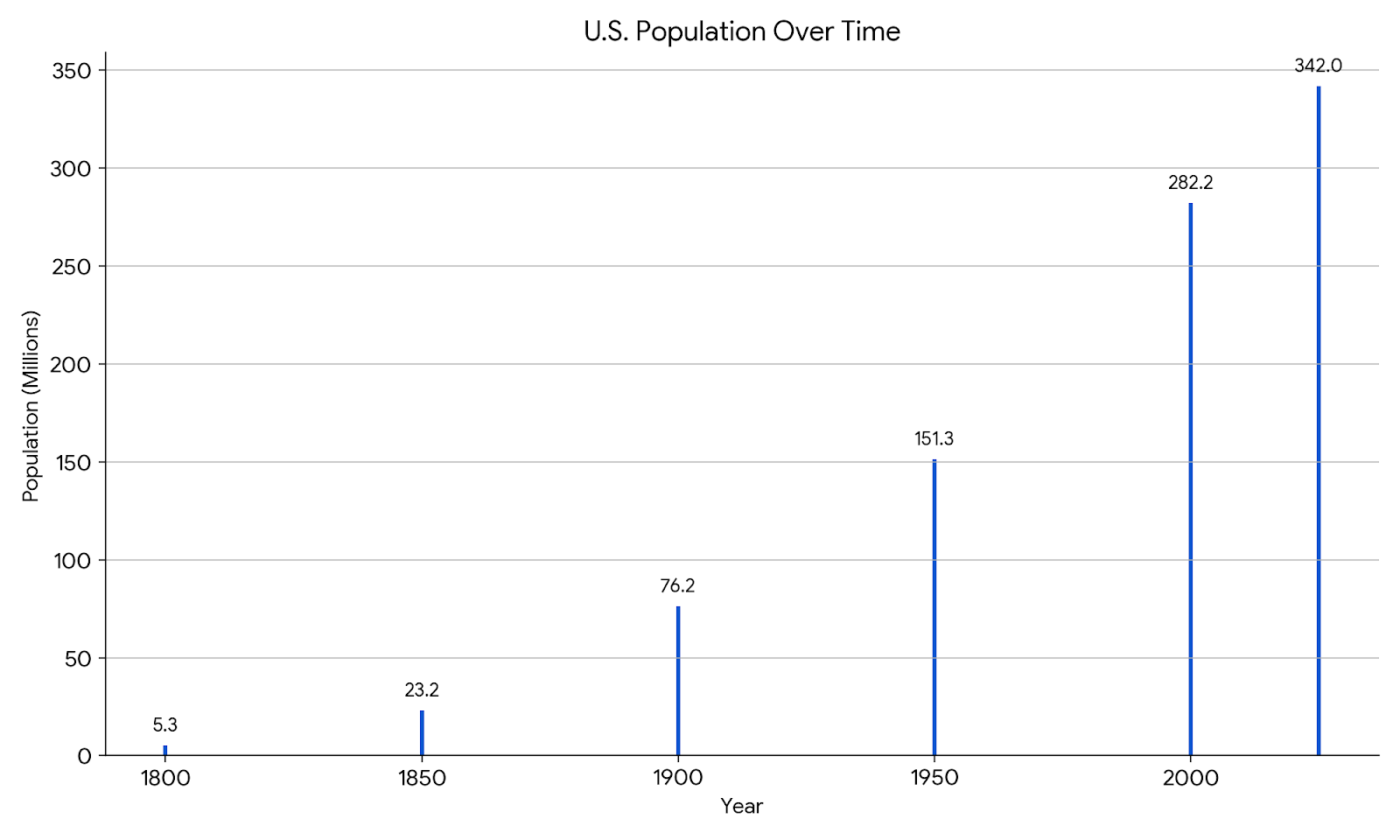
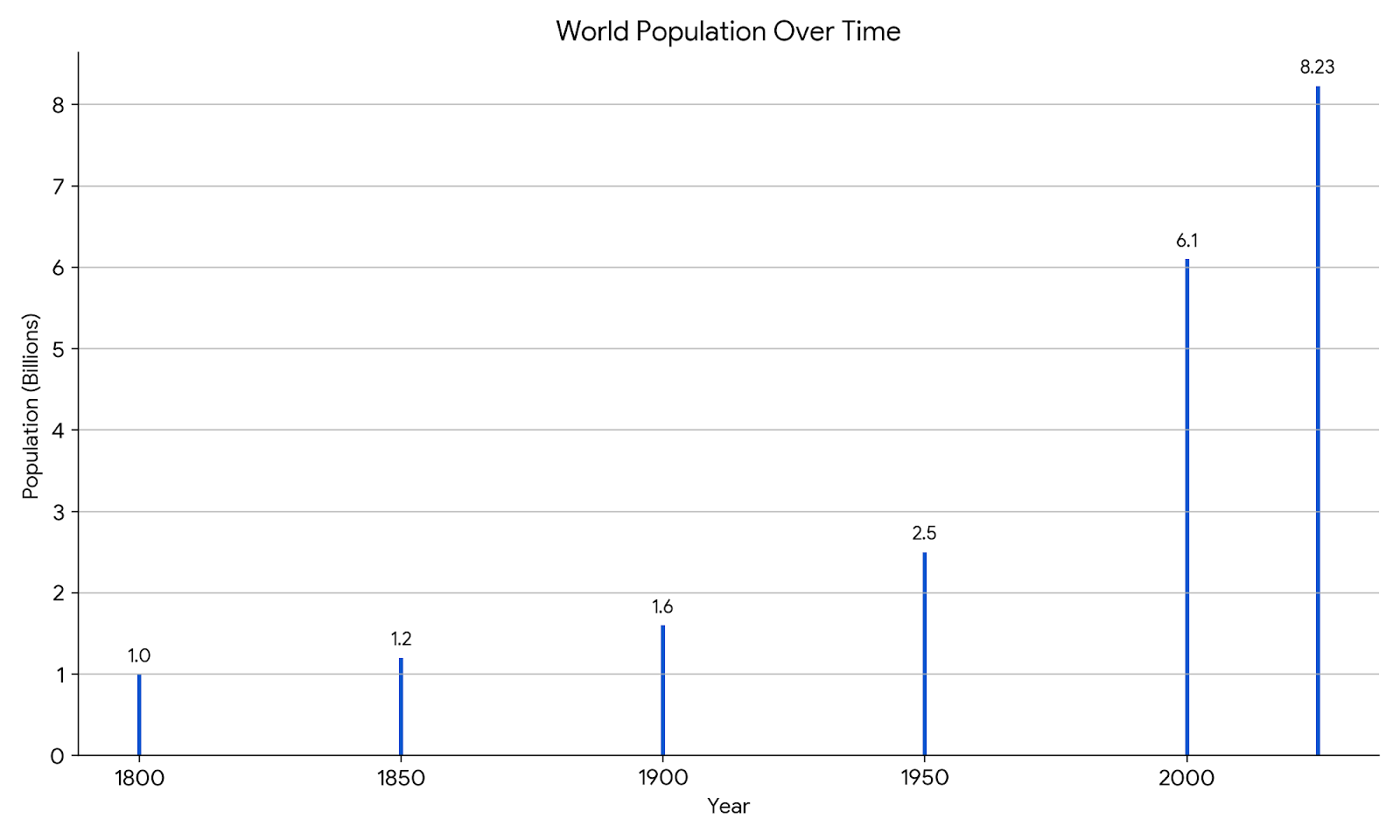
I asked AI to make me two charts … first, the population of the U.S. at 50-year increments and then the world’s population at 50-year increments.
The U.S. had 150-million people in 1950. We had only 76-million people in the year 1900. Now? We’re at 342-million. If we wonder why young people aren’t buying homes, maybe it’s because there just aren’t any and we’re running out of space to make any.
The world had 2.5-Billion (with a “B”) people in 1950. And only 1.6-Billion in the year 1900. Now? 8.23-Billion humans live on this planet. Have you ever thought about how many humans our planet could actually support? 16-Billion? 30-Billion? Logically, this number can’t keep growing infinitely. 100-Billion humans?
So I’d like to float a theory that, maybe, human nature and nature itself is causing the birth-rate slow down – it’s happening all over the world, actually. And if the total population of Earth slipped back to, oh, 7-Billion …and not because of some terrible pandemic or world war – and to that point, no wars at all would be a nice trade-off for a declining birth rate … if the Earth’s population went backward, what would be the harm? Somehow we humans figured things out when there were only 1-Billion and 2-Billion total humans. Back then, when we felt overcrowded, I think we just explored, moved on, and found “space.” Now, there’s no space, so young couples don’t feel a need to fill up space with babies.
This is just a theory. Probably a terrible theory. But I just want less crowded beaches, that’s all.
 Don Kowalewski